








You think you’re being responsible.
You’re not maxing out credit cards.
You’re paying things on time.
You’re using “0% interest” apps instead of high-interest debt.
So naturally, you assume you’re building a smart financial life.
Then one day, at 27 years old, you walk into a dealership or sit down with a mortgage lender expecting approval…
…and suddenly the numbers don’t work.
Your payment comes back way higher than expected.
Your interest rate is worse than your friend’s.
Or worse — the lender quietly tells you to wait six more months.
And you sit there confused because nobody ever warned you that ten little “harmless” payment plans for sneakers, clothes, electronics, gym equipment, vacations, and random online purchases were painting a picture of financial instability behind the scenes.
[Years ago, when I was working at a car dealership, I saw something happen over and over that completely changed the way I looked at money.
Young buyers would walk in confident.
Good job.
Clean clothes.
Nice phone.
Credit score looked decent on the surface.
They genuinely believed they were about to drive home in the car they wanted.
Then the financing would come back.
And sometimes the room got very quiet.
I remember one particular customer in his twenties who could not understand why his payment was coming back so high. He kept saying:
“But I pay everything on time.”
And technically, he was right.
But once the lenders started digging deeper, the real picture showed up.
His bank statements were loaded with small installment payments everywhere.
Buy Now, Pay Later purchases.
Financed electronics.
Furniture payments.
Tiny recurring obligations stacked on top of each other.
Nothing looked reckless by itself.
But together?
It made his entire financial life look stretched thin.
The lender did not see “responsible young guy.”
They saw somebody whose monthly cash flow was constantly fragmented.
I will never forget the look on his face when he realized that all those “harmless” little payment plans were now costing him a much higher car payment.
That moment stuck with me because I realized modern debt had changed.
Years ago, people feared debt because it looked dangerous.
Today, debt is packaged to feel convenient, normal, and even smart.
That is what makes it so dangerous now.
People are getting financially damaged while thinking they are being financially responsible.]
I’ve watched this happen for years.
Not because people are reckless.
Because modern debt got sneaky.
The Illusion of 0%
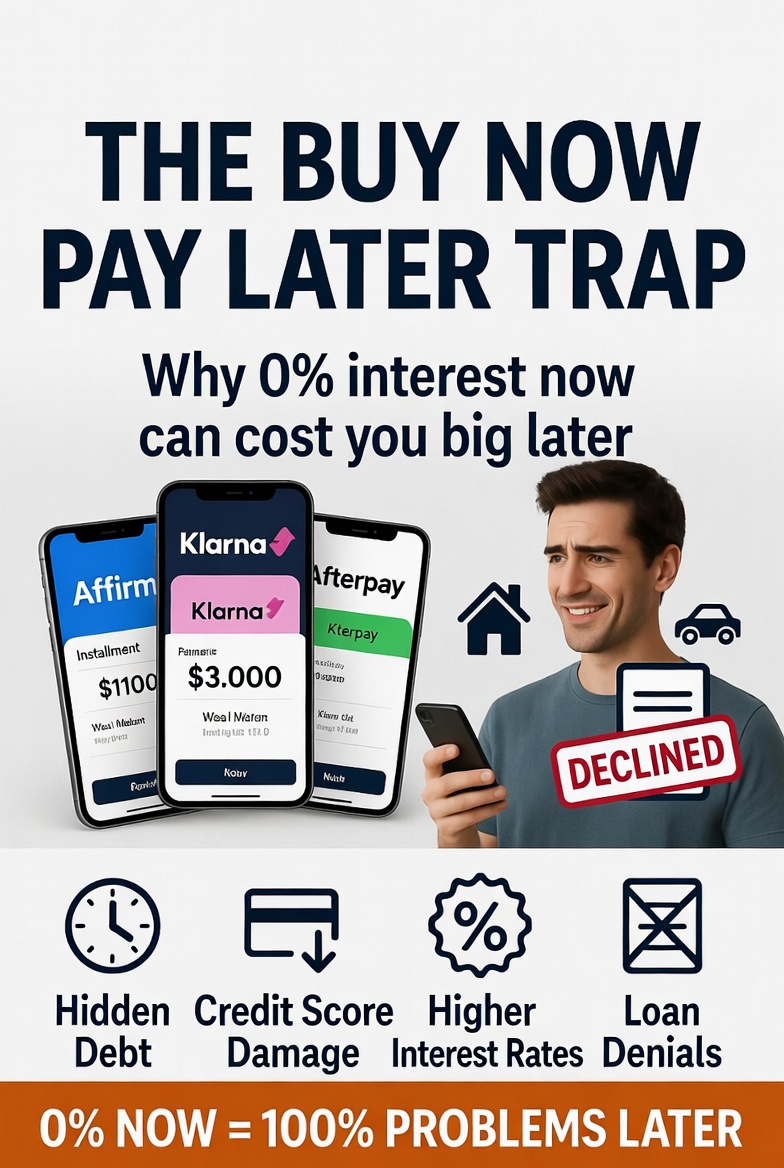
Apps like Affirm, Klarna, Afterpay, and similar Buy Now, Pay Later systems were designed to feel psychologically harmless.
That’s the entire business model.
“No interest.”
“Only four payments.”
“Instant approval.”
“Split your purchase.”
Sounds responsible.
But here’s what most people do not understand:
Mortgage lenders and car loan underwriters are not judging you emotionally.
They are judging patterns.
Algorithms now scan bank statements and spending behavior in ways people do not realize.
And when a lender sees constant micro-loans scattered across your financial life, this is often what they silently see:
- Somebody living too close to the edge every month
- Somebody depending on payment fragmentation to survive
- Somebody with weak cash-flow discipline
- Somebody vulnerable during financial stress
Even if every payment is technically on time.
That part shocks people.
Because they assume:
“I paid responsibly, so I look responsible.”
Not always.
The Debt-To-Income Trap Nobody Explains Properly
Let’s simplify this.
Imagine you make $5,000 a month after taxes.
Now imagine this is quietly happening:
- $82 Affirm payment
- $46 Klarna payment
- $29 subscription
- $110 financed furniture payment
- $67 electronics payment
- $54 gym equipment payment
- $95 credit card minimum
- $300 car insurance
- student loans
- phone bill
- rent
Individually?
Nothing looks catastrophic.
Combined?
You now have financial leakage everywhere.
This is what lenders call debt-to-income ratio.
In plain English:
“How much of your monthly income is already spoken for before life even begins?”
That ratio determines everything.
Your approval odds.
Your interest rate.
Your borrowing power.
Your monthly payment.
A person making $90,000 a year can still look financially fragile if their cash flow is chopped into fifty little obligations.
And here’s another thing young people miss:
Underwriters do not just study debt.
They study behavior.
Repeated BNPL usage creates what many lenders internally view as a “cash-flow stress signal.”
Meaning:
“If this person constantly needs to split small purchases into installments, what happens when real life punches them in the mouth?”
That sounds harsh.
But that is how lending works behind closed doors.
The Real-World Impact Hits Hard at 25 or 30
This is where the damage becomes real.
Let’s say two people apply for a car loan.
Same income.
Same age.
Similar credit score.
But one person has six active BNPL accounts running through their bank statements every month.
The other person doesn’t.
Who looks safer?
The second person.
Almost every time.
Now fast-forward to a first home purchase.
This is where people get blindsided.
Because mortgages are not based only on credit scores anymore.
Lenders examine:
- Spending patterns
- Account balances
- Cash reserves
- Payment behaviors
- Recurring obligations
- Monthly leftover cash flow
And small installment debt reduces your borrowing power more than people realize.
Sometimes dramatically.
That can mean:
- Smaller loan approval
- Higher down payment requirements
- Worse mortgage rate
- Higher car payment
- More conditions from underwriting
- Delayed approval
- Last-minute stress before closing
I have seen people lose tens of thousands of dollars over the life of a loan because their financial habits made them appear riskier than they actually were.
And the cruel part?
Most of them thought they were doing everything right.
The Psychological Trap Is Bigger Than The Loan
This goes deeper than numbers.
BNPL apps train your brain to normalize permanent monthly payments.
That is dangerous.
You stop asking:
“Can I afford this?”
And start asking:
“Can I afford the payment?”
That mindset quietly destroys wealth-building.
Because financially strong people protect monthly cash flow like oxygen.
They do not casually slice it apart for temporary dopamine purchases.
The modern economy wants you permanently subscribed to payments.
Car payments.
Phone payments.
Furniture payments.
Sneaker payments.
Vacation payments.
Everything payments.
Before you know it, your future paycheck already belongs to twenty different companies.
That is not freedom.
That is financial suffocation wearing fashionable clothes.
My Actionable Rule Of Thumb
Here is the rule I would give my own family.
If you plan to buy a house or finance a vehicle within the next 12 months:
Freeze all Buy Now, Pay Later activity immediately.
Not “slow down.”
Stop completely.
And ideally:
Close the accounts entirely 6 to 12 months before applying for a major loan.
Why so early?
Because lenders love stability.
They want to see calm bank statements.
Predictable spending.
Strong leftover cash flow.
Healthy savings behavior.
Not financial juggling.
Here is what I would replace the BNPL habit with:
1. Use A Simple “48-Hour Pause Rule”
If you want something non-essential, wait 48 hours before buying it.
Most impulse purchases die naturally.
2. Build A Small “Future Purchases” Account
Even $25 to $50 a week changes behavior.
You stop financing nonsense because cash starts feeling powerful again.
3. Protect Monthly Cash Flow Like Your Life Depends On It
Because financially?
It often does.
The less money obligated every month, the stronger you look to lenders.
4. Keep Your Bank Statements Clean Before Major Loans
This matters more than social media finance influencers admit.
Underwriters notice patterns.
And chaotic money movement creates questions.
5. Stop Trying To Look Rich Before You Become Stable
This one hurts.
But it is true.
A lot of BNPL spending is image maintenance.
Clothes.
Electronics.
Lifestyle upgrades.
Social pressure.
Meanwhile the truly wealthy person often has one superpower:
Patience.
Final Thought
A 0% interest payment plan can still cost you massively.
Not through interest.
Through opportunity.
A higher mortgage rate.
A denied loan.
A smaller house.
A more expensive car payment.
Years of unnecessary financial pressure.
That is the invisible cost nobody advertises.
The scary part is not that young people are irresponsible.
It is that they are being conditioned to mistake constant payments for financial health.
And those are two completely different things.