






I learned this lesson the hard way.
In my twenties, when I was still stuck in that long stretch of struggle—years where money always felt tight and options felt limited—credit cards didn’t feel like debt at first.
They felt like relief.
They felt like breathing space.
They felt like I finally had access to money I didn’t actually have.
And that is exactly where the problem starts.
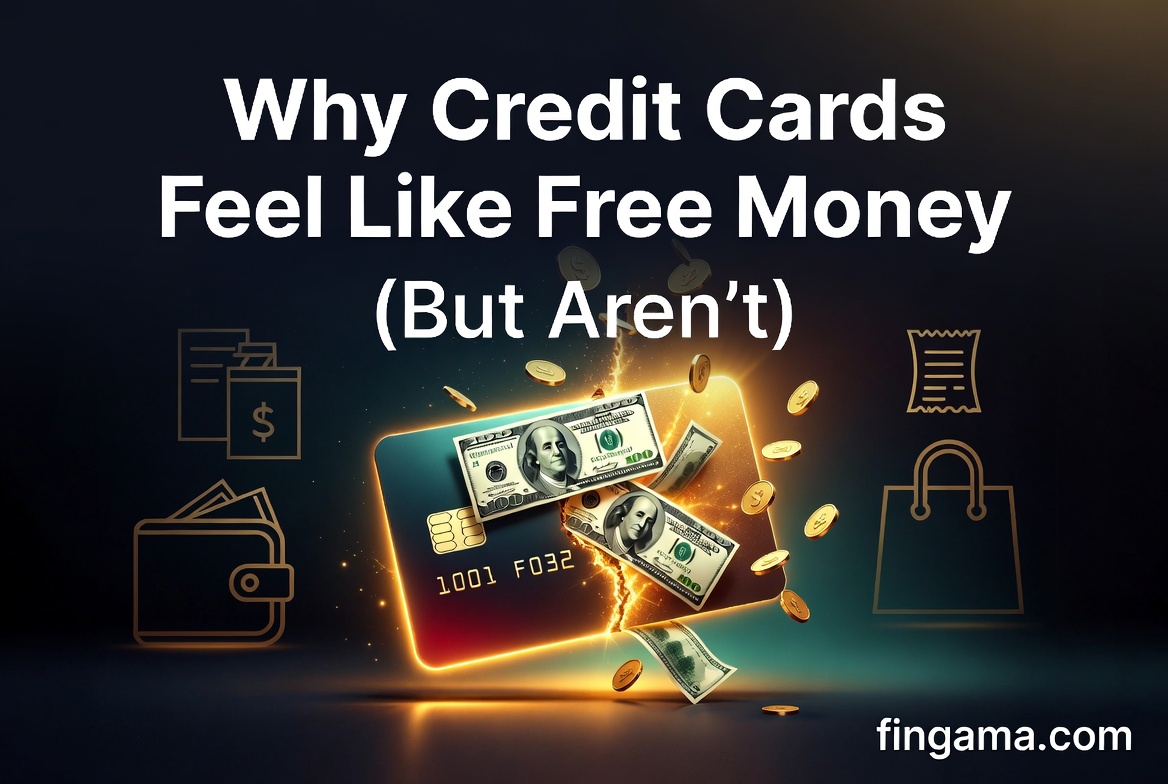
Because credit cards are designed to feel like free money… until reality shows up later.
The Illusion: “I Can Pay It Back Later”
When you’re in a tough financial situation, your thinking changes.
You stop asking:
- “Can I afford this right now?”
And start telling yourself:
- “I’ll figure it out later.”
That mindset is dangerous, but also very human.
I remember using credit cards thinking I was just “borrowing from my future self.”
But what I didn’t understand at the time was that my future self wasn’t magically richer.
My future self was just me… dealing with the same situation, plus interest.
That’s the part nobody really explains when you’re young and trying to survive.
Why Credit Cards Feel Like Free Money
Credit cards are designed very intelligently.
They don’t feel like cash leaving your hands.
You don’t physically see the money disappear.
Instead:
- you tap,
- swipe,
- or enter a number online.
No pain. No friction. No immediate consequence.
That’s why spending feels lighter than it actually is.
Cash forces reality. Credit hides it.
And when you’re already under stress or trying to escape a difficult environment, that lack of friction becomes very tempting.
My Reality at the Time
I wasn’t thinking about credit scores or interest rates.
I was thinking about:
- getting through the month,
- solving immediate problems,
- surviving financially,
- and trying to feel a little normal in a stressful situation.
Credit cards gave me that short-term relief.
But they also slowly created a cycle:
- spend → stress → minimum payment → repeat
And the worst part?
It didn’t feel like a crisis at first.
It felt manageable… until it wasn’t.
The Minimum Payment Trap
One of the biggest traps is the minimum payment.
At the time, it felt like:
“Okay, I’m keeping everything under control.”
But in reality:
- the balance barely moved,
- interest kept growing,
- and I stayed stuck longer than I realized.
Minimum payments don’t fix debt.
They just delay the pain.
And delaying financial pain often makes it worse.
That’s something I had to learn through experience, not theory.
The Emotional Side Nobody Talks About
Credit card debt isn’t just numbers.
It changes how you feel about money.
It creates:
- anxiety before bills,
- guilt after spending,
- stress you can’t fully explain,
- and a quiet pressure that follows you everywhere.
Even small purchases start to feel heavy.
And when you’re already dealing with life pressure, that extra mental weight adds up fast.
The Turning Point
At some point, I had to step back and look at the pattern honestly.
Not blame anyone. Not make excuses. Just look at reality.
The truth was simple:
- I wasn’t using credit cards as a tool.
- I was using them as a substitute for income stability.
And that never works long-term.
That realization changed how I approached money completely.
How I Rebuilt From It
Getting out of that cycle wasn’t instant.
It took time, discipline, and uncomfortable decisions:
- stopping unnecessary spending,
- focusing on paying down balances,
- rebuilding credit step by step,
- and learning how money actually behaves in the real world.
Over time, things improved.
Not because of luck—but because of structure and patience.
What I Wish I Understood Earlier
If I could go back and talk to my younger self, I wouldn’t say “don’t use credit cards.”
I would say:
- Credit cards are not income.
- They are not extra money.
- They are not a safety net you ignore consequences on.
They are a tool.
And like any tool, they either help you build something—or slowly break what you already have.
The Real Truth About “Free Money”
Credit cards feel like free money only at the beginning.
The cost shows up later:
- in interest,
- in stress,
- in reduced financial freedom,
- and in the time it takes to recover.
Nothing about it is actually free.
It’s just delayed.
Final Thought
I don’t look at credit cards the same way anymore.
Now I see them for what they are:
a financial tool that requires discipline, awareness, and respect.
If used properly, they can help build credit and structure.
If misunderstood, they can quietly create years of financial struggle.
I know that from experience—not theory.
And that’s why I write about it today.
Yours Truly,
Pete